This post about how to make a vision board contains affiliate links, which means I may earn a small commission at no extra cost to you if you purchase through one of these links. I only recommend gear and tools I actually use and trust.
Key Takeaways
- A running vision board focuses on specific race goals, helping runners stay motivated and accountable.
- Set clear 2027 race goals before creating a vision board, and consider using a physical or digital format that you will engage with daily.
- Include race-specific images, training metrics, and personal motivation to make your vision board effective.
- Find inspiration for your vision board on Pinterest by searching for targeted keywords related to running.
- Regularly view your vision board to reinforce your goals; place it in a location where you see it daily.
Throughout the year, I keep a running note in my phone’s note app with goals or experiences I’ve dreamed up as they come to mind, but I didn’t always track my goals this way. I used to stare at a blank sheet of paper on New Year’s Day and wonder where I wanted to grow my life. If that sounds familiar, you are not alone, and you are definitely not behind.
If the words vision board make you roll your eyes a little, I get it. Cutting out magazine photos of a life you do not currently have can feel a little woo-woo, especially when you are the kind of runner who wants a plan, not a mood board.
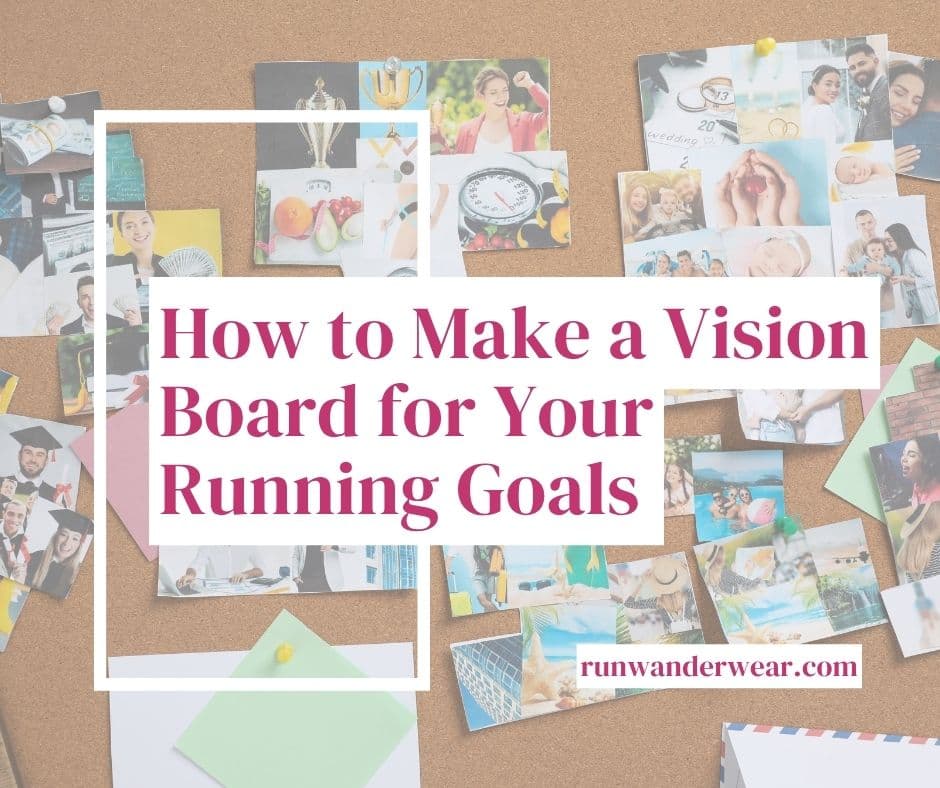
A running vision board is a different animal from the generic “manifest your dream house” version. It is not about hoping good things happen to you. It is about taking your 2027 race goals out of your head, where they are vague and easy to forget on a hard training day, and putting them somewhere you will actually see them.
Let’s take a deep dive into creating a vision board and what you’ll need to make one. By the end of this post, you will have a real running goals vision board, either physical or digital, built around specific 2027 race goals instead of a vague pile of running-shoe posts you saved from Instagram three years ago.
Topics Included in this Post
- What Is a Running Vision Board (and How It’s Different From a Regular One)
- Why Vision Boards Actually Work for Runners
- How to Create a Running Vision Board
- Step 1: Get Clear on Your 2027 Race Goals First
- Step 2: Choose Your Format (Physical vs. Digital)
- Step 3: What to Actually Put on a Running Vision Board
- Step 4: Where to Find Vision Board Inspiration
- Step 5: Actually Use It (Not Just Make It)
- FAQ: Running Vision Boards
- Start Small and Build From There
What Is a Running Vision Board (and How It’s Different From a Regular One)
A running vision board is a visual collage of images, words, and symbols dedicated specifically to your running goals. Unlike a general vision board, which might mix career goals, travel dreams, and relationship hopes into one collage, a running vision board stays specifically focused on running. It exists to help you stay locked in on marathon training milestones, whether that means finishing your first 5K, completing a run streak, running the Boston Marathon, or simply building a morning running habit that finally sticks.
The difference matters. A general vision board asks “what do I want my life to look like?” A running vision board asks a much more useful question for busy women juggling training with everything else: “what does the next race cycle need from me, and how do I remember that on the mornings I would rather hit snooze?”
Related Post: If a vision board isn’t your thing, consider making a running goals bingo board! I’ve made bingo cards as a fun way to support my goals and it’s an incredible way to gamify my goals and experiences!
Why Vision Boards Actually Work for Runners
Do vision boards actually work, or is this just a craft project that ends up in a closet by February? Fair question. Here is the short version of the psychology, no lab coat required.
Vision boards work by training your brain’s reticular activating system, the part that connects to your sensory stimulation. It helps filter out background noise and identifies what matters and helps you start noticing running opportunities and choices that move you toward your goal.
Vision Boards Help Build a “Runner Identity”
Seeing your race goals daily also builds a stronger “runner identity,” which research on habit formation consistently links to sticking with training longer than motivation alone ever does. Running is just as much mental as is it physical. And mental visualization itself, such as picturing yourself crossing that finish line strong, is a tool plenty of coaches (myself included) use to help runners prepare for hard miles before they ever lace up.
In practice, that means a vision board is not magic. It is a daily visual cue that reinforces the habit loop you are already trying to build, the same way a training plan taped to your fridge keeps you honest about tomorrow’s run.
How to Create a Running Vision Board
Let’s move from talking about vision boards to actually making one! This next section will walk through the steps to create a running vision board and what you’ll need to create one as a tangible focal point for your goals. If it helps, I’ve created a manifesting shopping list with fun items for visualizing your race goals!
Step 1: Get Clear on Your 2027 Race Goals First
Before you buy a poster board or open Canva, get specific about what you actually want from 2027. A vision board built on “I want to run more” will not deliver the results you’re looking for. A vision board built on “I want to run the Chicago Marathon as my first major” will.
Getting clear on your goals first also protects you from burnout, because it forces you to build a realistic race calendar instead of signing up for everything that looks fun in the moment (I am also guilty of this).
Try setting tiered goals the way a coach would:
- A-goal: Your main target race and the outcome you most want (a PR or a Boston qualifier time)
- B-goal: A tune-up race or secondary target that supports the A-goal without added pressure to simply finish your first marathon
- C-goal: A safe, low-stakes finish, a race you show up to purely for the experience
Once you have those three tiers, you also have a much clearer sense of what your training calendar (and your recovery time) actually needs to look like.
Pro Tip: Using A, B and C goals are also perfect for creating your race day strategies and expectations! For example, you could set your A-goal to set your race finish time as perfect race day conditions, injury-free. B-goal is slightly slower, but strong finish and C-goal as finishing the race.
Step 2: Choose Your Format (Physical vs. Digital)
There is no single right way to build a running vision board. The best format is the one you will actually look at regularly, so weigh these against your real life, not an idealized version of it.
Physical Vision Board Ideas
A physical board (corkboard, poster board, or a page in your training journal) is tactile and satisfying to build, and it works well if you already have a spot, like next to your coffee maker, where you will walk past it daily. Get fun push pins to add your personality to it (I love this push pin set in fun shapes and clips).
Digital Vision Board Options
A digital board (a Pinterest board, a Canva collage, or even your phone’s lock screen) takes less time to make, costs nothing, and travels with you, which matters if you are the kind of runner who is fairly busy or travels a lot.
Pro Tip: Get a cute cork board to add your photos and reuse it every time you plan a new set of race goals. There are so many styles on Amazon, like traditional boards to decorative felt boards.
Short on time? Try Using AI to Speed This Up
If cutting out magazine photos sounds like one more thing on your to-do list, a free AI image tool (like Canva’s built-in AI or ChatGPT’s image generation) can build you a starter collage in minutes. Try a prompt like this:
AI Prompt: “Create a motivational vision board collage for a woman training for a 2027 marathon. Include images representing early morning runs, a finish line moment, strength training, healthy meals, and the words ‘Consistency Over Intensity.’”
You can always personalize it afterward with your own race photos, but it is a fast way to get past a blank page.
Step 3: What to Actually Put on a Running Vision Board
This is where most vision boards go generic, and it is also where yours can be genuinely useful instead. Skip the stock photos of anonymous people running on a beach at sunset.
A running vision board should bridge the gap between your big 2027 dream and the daily training habits that actually help you decide if you’re ready to run a full marathon, so feature specific race medals, a mapped route of your dream goal race, real pace or mileage numbers, and photos of yourself feeling strong, not posed.
Process and Action Items to Include on a Vision Board
- The Routine: Photos representing early-morning discipline, stretching, and strength training
- The Fuel: Visuals of hydration, colorful meals, and recovery gear you love to create incentives to keep you going
- The Metrics: Specific target numbers, like a goal 5K pace, a weekly mileage total, or your race date
Vision Board Mindset and Milestones
- The Destination: Course maps, elevation profiles, or finish-line arches from your target race so you can visualize crossing the finish line
- The Feeling: Tap into the expressions of grit, joy, and runner’s high rather than posed model shots. Focus on the true feelings
- The Mantras: Short phrases like “Consistency over intensity” or “Stronger every mile”
Step 4: Where to Find Vision Board Inspiration
Pinterest is the fastest place to find running vision board ideas, and a few specific searches will get you better results than a generic “vision board” search. Try searching for keyword terms like:
- Running vision board ideas
- 2027 vision board ideas
- Fitness vision board
- Marathon bucket list
- Travel vision board (a good add if 2027 includes a destination race)
- Print your own pictures (make them stickers with this mini photo printer)
Save anything that gives you an actual feeling or keeps you motivated, calm, proud, rather than just anything pretty. That gut reaction is a better filter than aesthetics alone. The feelings and whimsy make the magic of manifesting your goals happen.
Step 5: Actually Use It (Not Just Make It)
Here is the part nobody talks about: most vision boards get made once and never looked at again. A board buried in a drawer will not do a thing for your 2027 race goals.
Put it somewhere your eyes actually land every day, taped inside your training log, propped by the coffee maker, or set as your phone’s lock screen so you see it before you even open your running app.
Pro Tip: I created a manifesting shopping list with products to help you focus on your race goals! Things like city candles, cork boards, journals and letter boards!
FAQ: Running Vision Boards
A vision board is a visual collage of images, words, and goals meant to keep what you are working toward in front of you daily. A running vision board narrows that focus specifically to race goals and training milestones.
They work as a consistency tool, not magic. Seeing your goals daily reinforces habit loops and keeps your “why” visible on hard training days, which is where most runners actually fall off track.
Race-specific images (course maps, medals), training metrics (pace, mileage goals), mantras, and personal motivation, not generic stock fitness photos.
Create a new board, search terms like “running vision board ideas” or “2027 vision board ideas,” and pin images that give you an emotional reaction, not just ones that look nice.
A good one is specific, not generic. It ties directly to a real race, a real date, and real numbers, rather than a vague collage of inspirational quotes.
Start Small and Build Your Vision From There
You do not need a Pinterest-perfect board to make this work. A running vision board is a tool, not a craft competition, so start with even five images and a race date, and add to it as your 2027 training builds. The goal is a board you will actually see, not one you will admire once and forget.
Want more running goal-setting tools like this delivered straight to your inbox? Subscribe to my newsletter and get running goal support in your inbox every week!










Leave a Reply